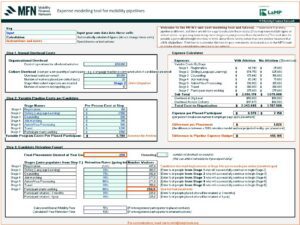
The Mobility Finance Network‘s June 2026 webinar introduced a toolkit that accounts for dropout rates and overhead to help price migration programs more accurately. MFN Founder and LaMP CFO Elicia Carmichael showed how to:
1. Understand how attrition affects per-unit cost calculations,
2. Apply a structured framework for capturing overhead in migration pricing, and
3. Build sharper, more defensible cost models for your programs.
You can access the session’s resources below:
Excel template: A ready-to-use version of the cost model shared during the workshop, so you can start applying it to your own programs right away.
Recording: In case you want to revisit how to use the tool or share it with a colleague who couldn’t attend.
Slides: You can use our slide deck to follow along with the video and reference later.
If you have any questions as you work through the template, or if you’d like to share how you’re applying it, don’t hesitate to reach out. We’d love to hear from you.
The Mobility Finance Network is an initiative powered by LaMP that fosters collaboration, knowledge-sharing, and innovation to cultivate financial tools for workers on the move and the businesses that support them. To learn more about the MFN, sign up for announcements here.
North Dakota faces one of the most acute labor shortages in the United States, with only 30 available workers for every 100 open jobs. In response, the state established the Global Talent Office (GTO) in 2023 to help businesses recruit and retain foreign-born talent–and turned to LaMP for expert guidance on building an effective, evidence-based labor mobility strategy.
Since 2024, LaMP has served as a strategic advisor to the GTO across two phases of engagement. In the first phase, in partnership with Dalberg Associates, LaMP led a comprehensive assessment of the state’s workforce gaps, employer barriers, and visa pathway options–delivering a prioritized roadmap that now guides the office’s work. In the second phase, LaMP continues to support implementation through research, stakeholder convenings, and hands-on technical assistance, including designing a first-of-its-kind public visa navigation tool and co-producing North Dakota’s annual Global Talent Summit.
North Dakota is at the frontier of state-led labor mobility innovation–and LaMP’s work with the GTO is helping establish a model other states can follow.
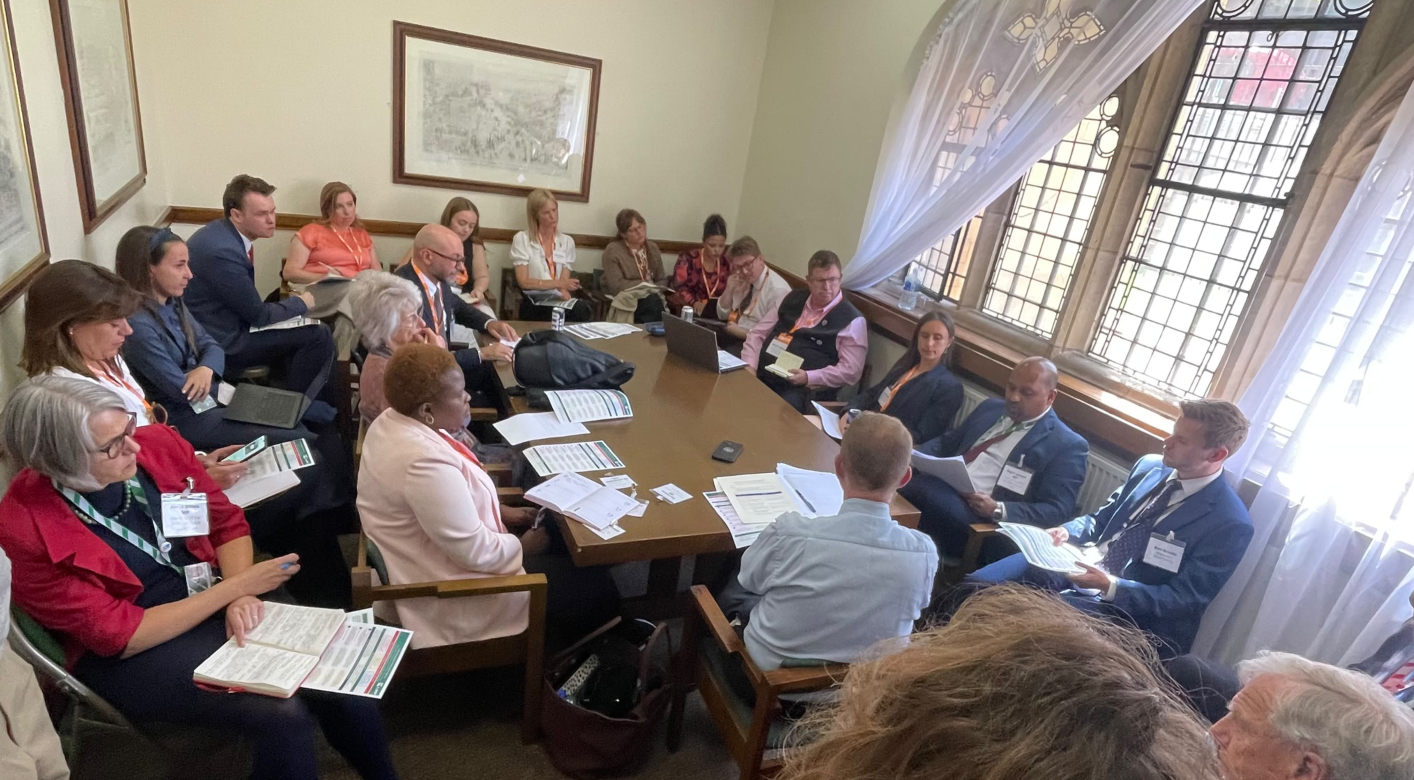
LaMP’s Salvatore Petronella and Laurel Hart brief MPs and peers at the APPG roundtable on Migration and Adult Social Care, 9 June 2026.
On 9 June 2026, LaMP’s Salvatore Petronella and Laurel Hart briefed MPs and peers at an All-Party Parliamentary Group (APPG) roundtable on Migration and Adult Social Care, chaired by Tim Farron MP. The discussion brought together representatives from across the migration and care sectors to examine how the UK’s migration system can better support workforce needs, protect workers, and deliver high-quality care.
Drawing on 15 months of consultation and engagement across the migration and care sectors, LaMP shared evidence and emerging proposals developed through conversations with more than 100 stakeholders, including care providers, employers, worker representatives, migrant workers, regional hubs, matching platforms, and policymakers.
One year on
The UK’s Immigration White Paper, published in May 2025, confirmed the closure of the adult social care visa route to new overseas applications – citing concerns over worker exploitation and a stated intention to end reliance on international recruitment in favor of domestic workforce development. One year on many of the challenges that prompted debate about the system remain unresolved.
By 2045, the number of people aged over 80 in the UK is projected to nearly double, and the sector is expected to require an additional 470,000 care workers. Around 131,000 vacancies remain unfilled, in the sector, while an estimated 20,000+ displaced migrant care workers remain out of work, with limited visibility of their skills, status or readiness to re-enter the sector.
Against this backdrop, LaMP presented a set of proposals aimed at addressing immediate workforce challenges while informing the design of any future migration pathway for the sector.
A dual-track response
Drawing on evidence gathered through its consultation process, LaMP outlined two levels of intervention: immediate action to address current system failures and a set of principles to guide future reform.
A central proposal is the creation of a streamlined national registry of care workers. Such a system would provide a clearer picture of the workforce, validate existing skills and qualifications, and support workers to move safely between employers. While many of the necessary components already exist, they remain fragmented across programs and institutions.
LaMP also highlighted the need for stronger workforce matching and upskilling programs. Existing regional matching initiatives via Regional Partnerships have achieved placement conversion rates of just 10–15% and have seen significant funding reductions. Better coordination and targeted investment could help connect displaced workers with vacancies more effectively while addressing skills gaps and supporting credential recognition.
Principles for future reform
Alongside immediate interventions, LaMP proposed four principles to inform the design of any future adult social care migration route:
Industry-led and demand-driven. Migration pathways should be informed by workforce planning data and responsive to genuine labor market needs through mechanisms such as a Temporary Shortage List.
Transparent, accountable and rights-respecting by design. Greater visa portability, effective grievance mechanisms, and stronger worker protections are essential to reducing vulnerability and exploitation. Participants noted that the current 60-day period for workers to secure a new sponsor following job loss is often unworkable.
Complementary to domestic workforce investment. International recruitment should form part of a broader workforce strategy rather than act as a substitute for investment in pay, progression, and retention. Median care worker pay currently stands at approximately £12 per hour.
Standards set at source. Government-to-government agreements with origin countries can provide for the institutional framework that supports ethical recruitment, strengthens pre-departure training and ensures greater certainty for workers before migration takes place.
Building consensus
The parliamentary briefing followed a workshop convened by LaMP and hosted by the Open Society Foundation the previous day. The workshop brought together 20 leaders from across the migration and care sectors to test evidence, challenge assumptions and refine proposals ahead of engagement with parliamentarians.
Across both discussions, participants reflected on the shortcomings of the current system for workers, employers and those who rely on care services. Concerns included the disruption caused by sponsor license suspensions, the vulnerability created by employer-tied visas, and the lack of coordination across government departments and regulators. There was broad support for a more joined-up approach to workforce matching, skills recognition and worker protection.
Looking ahead
The discussions reinforced the importance of coordinated engagement between the Home Office, the Department of Health and Social Care, care regulators and sector stakeholders in shaping future policy.
LaMP will continue to engage parliamentarians, government, and sector leaders in the months ahead, building on the momentum of these conversations and contributing to ongoing policy development in this area.
More information on LaMP’s UK program is available here.
North Dakota faces one of the most acute labor shortages in the United States, with only 30 available workers for every 100 open jobs. In response, the state established the Global Talent Office (GTO) in 2023 to help businesses recruit and retain foreign-born talent–and turned to LaMP for expert guidance on building an effective, evidence-based labor mobility strategy.
Since 2024, LaMP has served as a strategic advisor to the GTO across two phases of engagement. In the first phase, in partnership with Dalberg Associates, LaMP led a comprehensive assessment of the state’s workforce gaps, employer barriers, and visa pathway options–delivering a prioritized roadmap that now guides the office’s work. In the second phase, LaMP continues to support implementation through research, stakeholder convenings, and hands-on technical assistance, including designing a first-of-its-kind public visa navigation tool and co-producing North Dakota’s annual Global Talent Summit.
North Dakota is at the frontier of state-led labor mobility innovation–and LaMP’s work with the GTO is helping establish a model other states can follow.
In the first Matrix movie Agent Smith is holding Neo down on the subway tracks as a train approaches and says: “You hear that, Mr. Anderson? … That is the sound of inevitability…”
Demography has that flavor. Over the medium run (10 to 30 years) demography is perhaps the most predictable part of our future. After all, if you want to know how many people thirty year olds there will be in the economically distant future of 2056, just count babies today (with some modest adjustments).
Ageing: The Real Demographic Challenge
The primary phenomena that all rich industrial countries will experience over the next 30 years is not “de-population” – that is coming (see Geruso and Spears, here and here) just later – but ageing. Over the coming years the population of the labor force aged will fall absolutely and the population of those over 65 will rise by about the same amount. This means that the total population will stay about the same, but will be much older.
I have written papers that document the implications of that for the future of the ratio of the labor force aged to 65 plus (many of whom are also in the labor force) for the rich industrial countries using the standard global sources for population projections, with an emphasis on the “zero migration” scenarios (here and here).
What the Congressional Budget Office Data Shows
In this post I use the recent (January 2026) projections of the US population done by the Congressional Budget Office (CBO) to document these trends for the USA. While in previous papers I used global data to have comparability, here I use an official US source to focus on just the USA. A strength of the CBO data is that they have detailed projections of migration by age which allows the calculations of a “zero migration” scenario for specific age groups.
I use the CBO projections of the “Social Security” population of the USA and then use their data on the immigration and emigration to calculate the net immigration by age groups 0-19, 20 to 64, and 65 plus. I deduct the cumulated net immigration from the CBO projections to estimate the evolution of the labor force aged and 65 plus populations of the USA under the scenario of zero net immigration after 2026.
The Zero Net Immigration Scenario
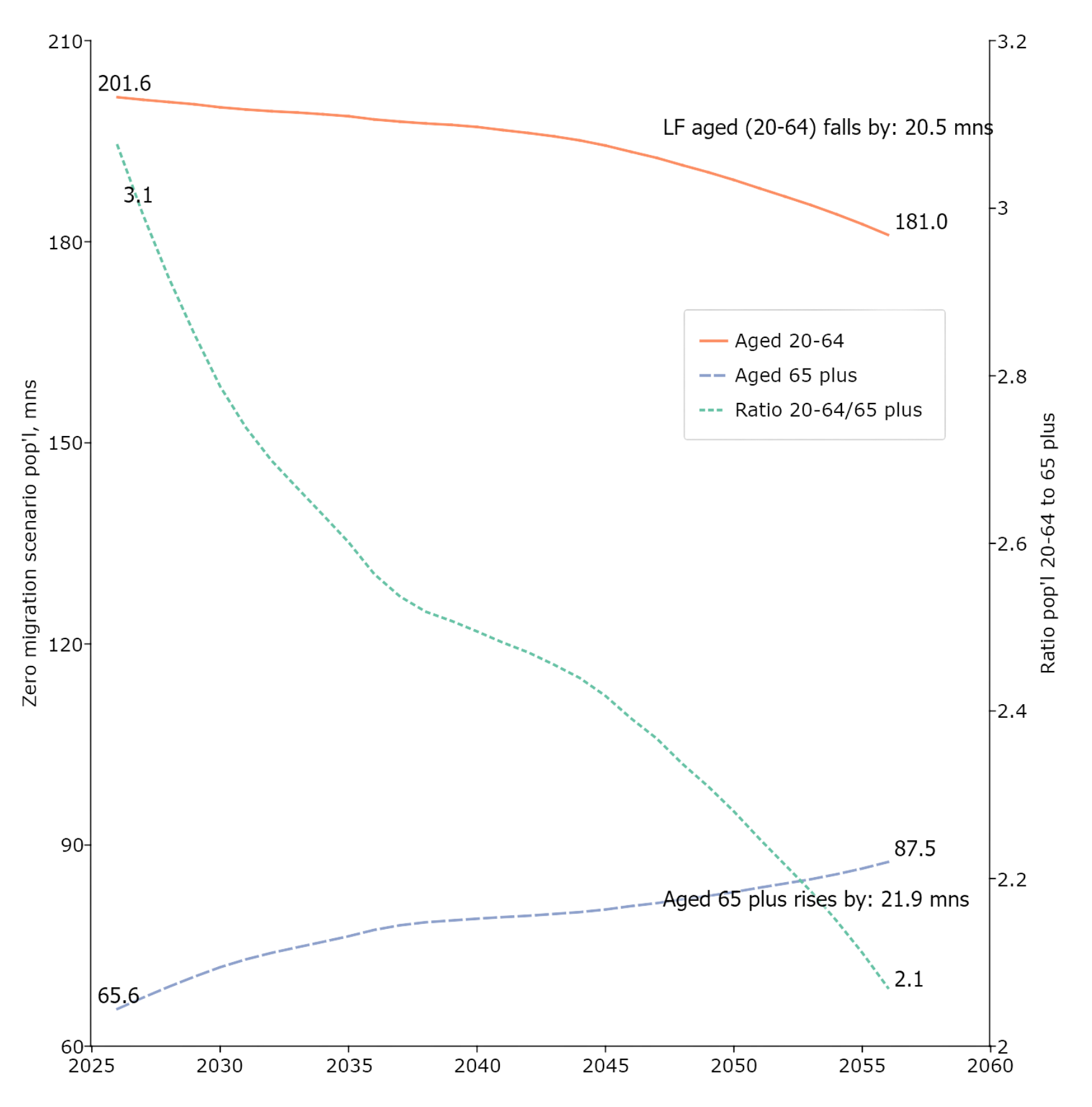
Figure 1: In a scenario of zero net immigration the labor force (LF) aged (20-64) population of the USA falls by 20.5 million and the 65 plus population rises 21.9 million. The ratio of labor force aged to 65 plus falls from 3.1 to 2.1.
Source: My calculations with data from the downloadable CBO data.
Between 2026 and 2056 the adult population of the USA actually rises a bit (the total population falls as, like the labor force aged, the young population falls substantially) but only because the rise in the 65 plus population offsets the fall in the labor force aged.
“Locked In”: Why Births Today Won’t Save Us
While there is a lot of debate currently about what, if anything, can be done to raise the number of births (Kearney and Levine 2022, 2025, Geruso and Spears 2026, Gauthier and Gietel-Basten 2025, Doepke et al 2023), over these horizons of a few decades the demographic is nearly all “locked in” (Goldstone). Even if births began to rise tomorrow, and rose steadily and substantially, this was no impact on the number of labor force aged 10 or 20 years from now as it just always takes a year for a person to be a year older and barely make a dent even by 2056.
While the decline in the total labor force aged is gradual and the slope seems modest. it is important. One, this is a qualitatively different demographic future than the USA’s past where “rates of natural increase” (births less deaths) led to a growing labor force. Two, from 2026 to 2036 the zero-migration scenario labor force aged declines by 3.32 million people, which is only cumulatively about 1.5 percent. But the population of Pittsburgh (not SMSA, just city) in 2024 was 307,000 and Cincinnati’s population was 315,000. So every year the USA loses a Pittsburgh or Cincinnati in the labor force aged. Three, even the gradual losses cumulate. The cumulative decline by 2056 is 20.5 million which is the combined population of the Metro areas (Standard Metropolitan Statistical Areas, not just city limits) populations of: Orlando, Charlotte, Baltimore, St. Louis, San Antonio, Oakland, and Miami).
But again, the demographic challenge is not so much the absolute decline in labor force aged but the combination of that decline with a larger increase in the population over 65. This matters fiscally as substantial parts of US budget are labor tax financed programs for those over 65 (Social Security and Medicare) – hence the interest of the CBO in long-run demographic projections. If we call the ratio of 20-64 to 65 plus the “support ratio” this falls from 3.1 in 2026 (and the fiscal squeeze is already felt) to only 2.1 in 2056. At current labor force participation rates this would imply well less than two people in the labor force for every person over 65.
The Gap That Needs Filling
Starting from the zero migration scenario we can ask “how many additional labor force aged people would be required to keep the support ratio at its current value of 3.07?” The results are shown in Table 1 for 2036 and 2056. This is where the numbers get eye-popping. Between 2026 and 2036 Labor force aged (20-64) population only falls by 3.32 million. But the 65 plus population grew by 11.8 million. To keep the support ratio constant at its 2026 value of 3.07 that means the USA would need 36.25 more people of labor force age. Otherwise, in just 10 years the support ratio would fall from 3.07 to 2.56. That means the “labor force aged gap for a constant support ratio” is 39.6 million people even after only 10 years of zero migration.
And by 2056 these numbers are very large. The labor force gap is 87.9 million people. There are 21.9 million more old which is a 2026 support ratio constant need for 67.4 million more labor force aged but the demography with zero migration produces 20.5 million less labor force aged.
Table 1: Additional population of labor force aged to keep the support ratio (labor force aged to 65 plus) constant at its 2026 value relative to a zero migration scenario
Year
Total additional labor force aged needed (mns)
(col IV less II)
Decline in labor force aged relative to 2026 (mns)
Increase in 65 plus population relative to 2026 (mns)
Additional LF aged needed to keep support ratio at 2026 level (mns)
Ratio in zero migration scenario
I
II
III
IV
V
2026
0.00
0.00
0.00
0.00
3.07
2036
39.57
−3.32
11.79
36.25
2.56
2056
87.94
−20.54
21.92
67.40
2.07
Source: My calculations with CBO data.
In this particular blog I am just laying out the implications of existing demographic projections, not carrying out an analysis nor making “recommendations.” The facts are that the absence of some terrible catastrophe there will be many more people over 65 in the future. And there will be many fewer younger people, including many fewer people in the traditional ages for high labor force participation. This will have many consequences for the economy and the fiscal balances of the federal government and policy will have to adjust to these demographic shifts in ways that are going to be political painful (raising taxes on the few number of workers would be painful, lowering pension or health benefits of the older population would be painful). One margin of adjustment is creating more legal modalities for labor mobility.
The UK faces a rapidly ageing population, with demand for social care outpacing supply despite efforts to expand the domestic workforce. At the same time, the closure of the Health and Care Worker visa to new applicants in July 2025 has left employers struggling to meet demand, limiting access to experienced overseas care workers and leaving providers short-staffed and the economy exposed.
Our Approach
The Labour Mobility Partnerships UK programme tackles this challenge through a two-pronged strategy:
– Practical Bridging & Skills Response – Displaced care workers who are already trained and experienced can be protected and redeployed quickly through bridging programmes. This addresses urgent care demand, supports worker retention, and reduces exploitation risks.
– Systemic Reform – Advocating for a smarter, future-proof immigration framework that aligns labour mobility with structural demographic needs, ensures access to critical occupations, and strengthens the UK’s long-term social care capacity.
We deliver this work through consultation and dialogue with government, public and private sector, civil society organisations, and migrant workers. By anchoring our efforts in the care sector, we demonstrate what is possible today, build the evidence base for policy reforms, and create a space for constructive dialogue on how migration systems can better meet labour market needs.
This programme is supported by the Open Society Foundations (OSF).
Looking Ahead
By focusing on the care sector, we can develop and test practical solutions for workforce mobility, skills recognition, and visa portability. These lessons create a blueprint that can be adapted to other sectors experiencing labour shortages.
The Mobility Finance Network‘s June 2026 webinar introduced a toolkit that accounts for dropout rates and overhead to help price migration programs more accurately. MFN Founder and LaMP CFO Elicia Carmichael showed how to:
1. Understand how attrition affects per-unit cost calculations,
2. Apply a structured framework for capturing overhead in migration pricing, and
3. Build sharper, more defensible cost models for your programs.
You can access the session’s resources below:
Excel template: A ready-to-use version of the cost model shared during the workshop, so you can start applying it to your own programs right away.
Recording: In case you want to revisit how to use the tool or share it with a colleague who couldn’t attend.
Slides: You can use our slide deck to follow along with the video and reference later.
If you have any questions as you work through the template, or if you’d like to share how you’re applying it, don’t hesitate to reach out. We’d love to hear from you.
The Mobility Finance Network is an initiative powered by LaMP that fosters collaboration, knowledge-sharing, and innovation to cultivate financial tools for workers on the move and the businesses that support them. To learn more about the MFN, sign up for announcements here.
The UK faces a rapidly ageing population, with demand for social care outpacing supply despite efforts to expand the domestic workforce. At the same time, the closure of the Health and Care Worker visa to new applicants in July 2025 has left employers struggling to meet demand, limiting access to experienced overseas care workers and leaving providers short-staffed and the economy exposed.
Our Approach
The Labour Mobility Partnerships UK programme tackles this challenge through a two-pronged strategy:
– Practical Bridging & Skills Response – Displaced care workers who are already trained and experienced can be protected and redeployed quickly through bridging programmes. This addresses urgent care demand, supports worker retention, and reduces exploitation risks.
– Systemic Reform – Advocating for a smarter, future-proof immigration framework that aligns labour mobility with structural demographic needs, ensures access to critical occupations, and strengthens the UK’s long-term social care capacity.
We deliver this work through consultation and dialogue with government, public and private sector, civil society organisations, and migrant workers. By anchoring our efforts in the care sector, we demonstrate what is possible today, build the evidence base for policy reforms, and create a space for constructive dialogue on how migration systems can better meet labour market needs.
This programme is supported by the Open Society Foundations (OSF).
Looking Ahead
By focusing on the care sector, we can develop and test practical solutions for workforce mobility, skills recognition, and visa portability. These lessons create a blueprint that can be adapted to other sectors experiencing labour shortages.
The Mobility Finance Network‘s June 2026 webinar introduced a toolkit that accounts for dropout rates and overhead to help price migration programs more accurately. MFN Founder and LaMP CFO Elicia Carmichael showed how to:
1. Understand how attrition affects per-unit cost calculations,
2. Apply a structured framework for capturing overhead in migration pricing, and
3. Build sharper, more defensible cost models for your programs.
You can access the session’s resources below:
Excel template: A ready-to-use version of the cost model shared during the workshop, so you can start applying it to your own programs right away.
Recording: In case you want to revisit how to use the tool or share it with a colleague who couldn’t attend.
Slides: You can use our slide deck to follow along with the video and reference later.
If you have any questions as you work through the template, or if you’d like to share how you’re applying it, don’t hesitate to reach out. We’d love to hear from you.
The Mobility Finance Network is an initiative powered by LaMP that fosters collaboration, knowledge-sharing, and innovation to cultivate financial tools for workers on the move and the businesses that support them. To learn more about the MFN, sign up for announcements here.
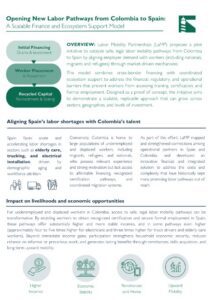
This brief outlines potential labor mobility pathways from Latin America to Spain for workers (including nationals, migrants and refugees). Labor Mobility Partnerships (LaMP) completed an eight-month scoping effort to identify viable and scalable program models across sectors facing acute labor shortages, including trucking hospitality, construction, and elderly care. This document highlights LaMP’s proposal for a pilot initiative to catalyze safe, legal labor mobility pathways from Colombia to Spain by aligning employer demand with workers (including nationals, migrants and refugees) through market-driven mechanisms.
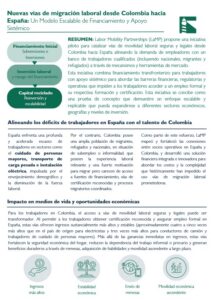
This brief outlines potential labor mobility pathways from Latin America to Spain for workers (including nationals, migrants and refugees). Labor Mobility Partnerships (LaMP) completed an eight-month scoping effort to identify viable and scalable program models across sectors facing acute labor shortages, including trucking hospitality, construction, and elderly care. This document highlights LaMP’s proposal for a pilot initiative to catalyze safe, legal labor mobility pathways from Colombia to Spain by aligning employer demand with workers (including nationals, migrants and refugees) through market-driven mechanisms.
Be part of the movement shaping the future of global labor mobility. Connect with leaders across recruitment, training, finance, technology, government and investment to establish a shared vision, address sector-wide challenges and accelerate collective progress.