

Tag: responsible recruitment

Rwanda-Germany Pathway: Structured Design with an Eye for Discovery

Photo by Mikhail Nilov

Building a first-of-its-kind Rwanda-to-Germany refugee mobility pathway required careful design choices across multiple partners, regulatory environments, and uncertain terrain. Through six months of research, workshops, and field visits, LaMP defined mission-critical elements and equipped partners with decision-making tools.

Below are three critical design considerations that shaped this pilot.


1. Ausbildung vs. Direct Employment

LaMP and our partners initially aimed to test both apprenticeship (Ausbildung) and direct employment tracks. Each model carries distinct trade-offs: apprenticeships offer quicker employer buy-in but longer ISA repayment horizons (up to 4 years), while direct employment promises higher ROI and greater scalability but requires stronger confidence in training quality and credential verification.

Pathway Advantages Disadvantages
Apprenticeship • Easier employer buy-in
• Previous Malengo experience (Kenya-Germany)
• 4-year timeline reduces ISA ROI
• High language investment, uncertain outcome
Direct Employment • Higher ROI (1-2 years to repayment)
• Larger scale potential
• Some roles don’t require German
• Harder to build employer trust
• Limited qualified refugees
• No Rwanda-Germany credential recognition system

Key questions guided our decision-making:

  • Can Rwanda supply sufficient qualified talent for both tracks within a restricted refugee pool? Should placement be in-house or outsourced?
  • Could credential recognition hurdles slow direct employment progress?

We concluded that apprenticeships were the most practical model because they offered a standardized entry route with clearer criteria.

At this stage, partnering with TERN enabled quick launch while reducing risk. TERN brought an established employer network and compliance infrastructure, while the partnership allows Malengo to gradually build in-house expertise for future scale.

2. Solving for Language: 70% of Success

Language is the single biggest success determinant for Germany. Employers require at least B2-level German—a 12-month journey demanding 20+ hours weekly study, often forcing candidates to pause education and work.

Three questions guided our language training design:

  • How: Would classes be virtual, in-person, or hybrid? Language schools confirmed virtual options would risk lower pass rates.
  • Where: Would classes take place in camps or in Kigali? Limited teacher availability and higher costs for camp instruction pushed the decision toward Kigali, especially for a pilot requiring tight control.
  • Who: Which partner could deliver 70% B2 pass rates cost-effectively?

At this point, Be Ubuntu emerged as the strongest fit: they mobilized within six weeks, deployed multiple Kigali-based instructors, and delivered intensive programming. The founder’s role as a certified German examiner based full-time in Rwanda was an additional advantage.

3. Income Share Agreements for Financing

ISAs would serve as the primary financing vehicle but implementing them introduced complexity. Malengo had limited legal registration in Rwanda; Kepler had never managed cross-border financial instruments. At this stage, the key questions were:

  • How to structure ISAs legally across borders?
  • Which partner could originate contracts without compliance risk?

Initial explorations with financial institutions proved too costly or slow. The solution finally emerged when Kepler identified a way to originate ISAs locally under its educational mandate, then legally transfer them to Malengo for repayment management in Germany. This creative alliance delivered the best balance of compliance, sustainability, and speed.

Looking Forward to 2026

Pilot implementation launched in July 2025 and is currently on track, with students performing at the top of their category for German learners in Rwanda. We expect candidates to pass their B2 exams by July 2026 and travel to Germany in August—turning months of preparation into tangible results.


To learn more or get involved, please contact Dawit M. Dame: ddame@lampforum.org

 

Pioneering Pathways: Design Lessons from Rwanda–Germany Refugee Mobility Pilot

Photo by Mikhail Nilov

Building a first-of-its-kind Rwanda-to-Germany refugee mobility pathway required careful design choices across multiple partners, regulatory environments, and uncertain terrain. Through six months of research, workshops, and field visits, LaMP defined mission-critical elements and equipped partners with decision-making tools.

Below are three critical design considerations that shaped this pilot.


1. Ausbildung vs. Direct Employment

LaMP and our partners initially aimed to test both apprenticeship (Ausbildung) and direct employment tracks. Each model carries distinct trade-offs: apprenticeships offer quicker employer buy-in but longer ISA repayment horizons (up to 4 years), while direct employment promises higher ROI and greater scalability but requires stronger confidence in training quality and credential verification.

Pathway Advantages Disadvantages
Apprenticeship • Easier employer buy-in
• Previous Malengo experience (Kenya-Germany)
• 4-year timeline reduces ISA ROI
• High language investment, uncertain outcome
Direct Employment • Higher ROI (1-2 years to repayment)
• Larger scale potential
• Some roles don’t require German
• Harder to build employer trust
• Limited qualified refugees
• No Rwanda-Germany credential recognition system

Key questions guided our decision-making:

  • Can Rwanda supply sufficient qualified talent for both tracks within a restricted refugee pool? Should placement be in-house or outsourced?
  • Could credential recognition hurdles slow direct employment progress?

We concluded that apprenticeships were the most practical model because they offered a standardized entry route with clearer criteria.

At this stage, partnering with TERN enabled quick launch while reducing risk. TERN brought an established employer network and compliance infrastructure, while the partnership allows Malengo to gradually build in-house expertise for future scale.

2. Solving for Language: 70% of Success

Language is the single biggest success determinant for Germany. Employers require at least B2-level German—a 12-month journey demanding 20+ hours weekly study, often forcing candidates to pause education and work.

Three questions guided our language training design:

  • How: Would classes be virtual, in-person, or hybrid? Language schools confirmed virtual options would risk lower pass rates.
  • Where: Would classes take place in camps or in Kigali? Limited teacher availability and higher costs for camp instruction pushed the decision toward Kigali, especially for a pilot requiring tight control.
  • Who: Which partner could deliver 70% B2 pass rates cost-effectively?

At this point, Be Ubuntu emerged as the strongest fit: they mobilized within six weeks, deployed multiple Kigali-based instructors, and delivered intensive programming. The founder’s role as a certified German examiner based full-time in Rwanda was an additional advantage.

3. Income Share Agreements for Financing

ISAs would serve as the primary financing vehicle but implementing them introduced complexity. Malengo had limited legal registration in Rwanda; Kepler had never managed cross-border financial instruments. At this stage, the key questions were:

  • How to structure ISAs legally across borders?
  • Which partner could originate contracts without compliance risk?

Initial explorations with financial institutions proved too costly or slow. The solution finally emerged when Kepler identified a way to originate ISAs locally under its educational mandate, then legally transfer them to Malengo for repayment management in Germany. This creative alliance delivered the best balance of compliance, sustainability, and speed.

Looking Forward to 2026

Pilot implementation launched in July 2025 and is currently on track, with students performing at the top of their category for German learners in Rwanda. We expect candidates to pass their B2 exams by July 2026 and travel to Germany in August—turning months of preparation into tangible results.


To learn more or get involved, please contact Dawit M. Dame: ddame@lampforum.org
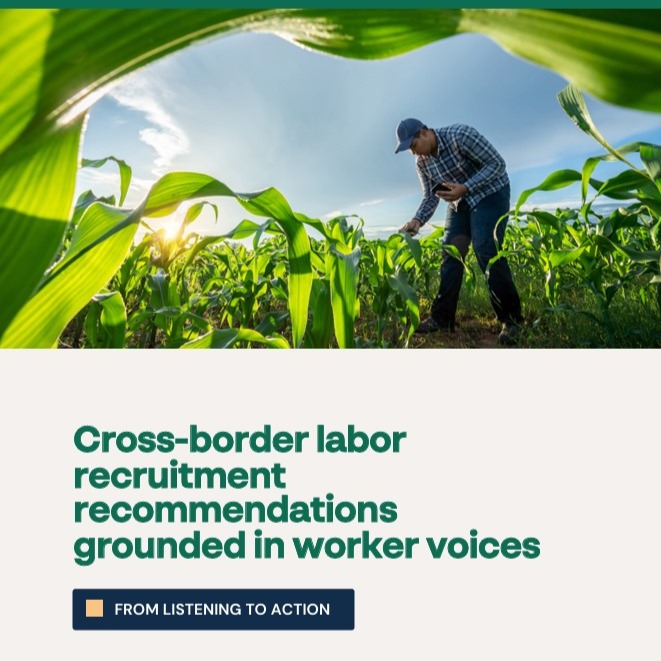
 

Cross-border labor recruitment recommendations grounded in worker voices: From listening to action

Building on our previous report, which focused primarily on the U.S. H-2A program, this 2025 report expands the scope to include workers from both Mexico and Guatemala participating in U.S. and Canadian seasonal work visa pathways. While our 2023 report focused on describing worker experiences through both quantitative and qualitative data, this year’s report goes a step further, offering actionable recommendations grounded in two years of worker insights.  

Our findings reflect what workers told us and what we’ve learned through ongoing engagement with employers and recruiters. The Worker Voice Survey continues to demonstrate that better recruitment is both possible and within reach. Listening to workers, and acting on their feedback, remains one of the most effective ways to build safer, more transparent migration pathways that benefit all parties. 

We invite you to explore the full report to gain a clearer view of workers’ realities and uncover practical insights to strengthen the recruitment process.


For more information, contact:

Kim Geronimo

kgeronimo@lampforum.org


Expanding Responsible Recruitment from Guatemala

For Guatemala, a country rich in talent and potential, legal labor pathways abroad offer a life-changing opportunity for thousands of workers. A 2023 study by the organization Action Against Hunger (Acción contra el Hambre) found that Guatemalan workers involved in seasonal labor programs in Canada and the United States experienced increased sending of remittances, improved economic situations for households of migrant families, and a greater availability of work for those who stay behind.1 Temporary labor opportunities through schemes like H-2A visas in the United States and the SAWP in Canada consistently grow as labor demand in those destination countries increases each year. That said, Guatemalans’ ability to access these opportunities is often complicated, at best. Complex bureaucratic requirements and the presence of malicious actors can make even regular migration pathways risky.2

Private Sector Recruiters Lead the Way for Responsible Labor Mobility in Guatemala

Launched in 2023, the Association of Responsible International Recruitment Agencies (GAREX for its initials in Spanish) emerged out of a collective desire to transform Guatemala’s labor recruitment ecosystem. The first responsible recruitment association in Latin America, GAREX is conformed of twelve Guatemalan recruitment agencies united by a mission to promote safe, transparent, and ethical recruitment practices for Guatemalans. Each year, its members help connect more than 20,000 Guatemalan workers to jobs in sectors like agriculture, construction, hospitality, landscaping, and food processing—primarily in the U.S., Canada, and Mexico.

As private sector labor recruiting agencies, GAREX members carry the responsibility of protecting migrant workers’ rights and ensuring compliance and transparency in their operations. GAREX has also recently taken the important step of developing an internal Code of Conduct and Complementary Protocol which establish concrete mechanisms to ensure adherence to the association’s rules and principles. In doing so, GAREX is further fostering a system of mutual accountability—not only by aligning quality standards, but also by equipping members with practical tools that build towards consistent responsible recruitment services.

GAREX: A Regional First Mover 

The services and activities of GAREX members have, from the start, gone beyond job placement alone. Member agencies guide workers and employers through every step of the recruitment journey—from visa processing and travel logistics to pre-departure orientation for employers and workers alike. Their operations provide a much-needed alternative to irregular migration while maintaining high standards of responsible recruitment services. Now united under GAREX, these agencies are not just filling jobs—they are collectively leading by example. To date, the association has:

  • Inter-governmental collaboration: established cooperation with key government entities such as Guatemala’s Ministry of Labor and the Migration Institute to ensure faster passport processing and worker protections while abroad; 
  • Multi-sectoral partnerships: built ongoing partnerships with international organizations like the International Organization for Migration (IOM) and the International Labor Organization (ILO) to leverage the knowledge and experiences of diverse actors and achieve the shared goals of responsible and ethical labor mobility; 
  • Responsible recruitment promotion: participated in international forums, like with the National Council of Agriculture Employers (NCAE), to attract more opportunities for Guatemalans abroad and promote responsible recruitment practices; and 
  • Association principles formation: agreed upon association principles and signed the ILO Code of Conduct for Recruitment Agencies of Migrant Workers. Through support from LaMP, GAREX members have also recently developed their own internal Code of Conduct and Complementary Protocol.

This Code of Conduct and Complementary Protocol draw on the ILO code of conduct but take a more targeted approach to the principles, rules, and circumstances pertaining specifically to responsible recruitment practices for private sector recruiters as an association. This includes developing tailored principles of inter-member relationships, the prevention and management of conflicts of interest, and a mechanism for member infractions and sanctions. More information about the Code of Conduct and Complementary Protocol content can be found below.

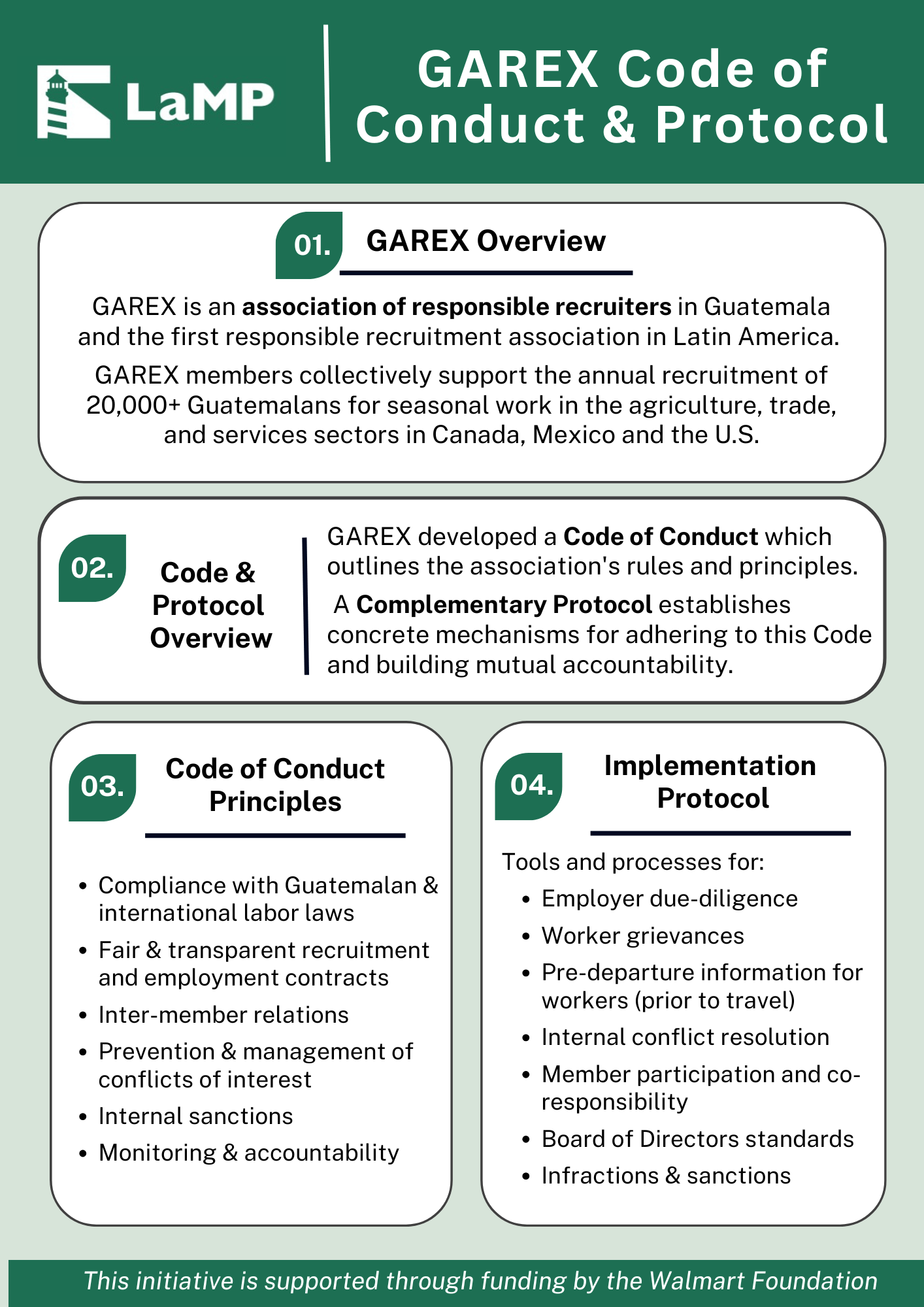
LaMP GAREX Code of Conduct & Protocol 01. GAREX Overview GAREX is an association of responsible recruiters in Guatemala and the first responsible recruitment association in Latin America. GAREX members collectively support the annual recruitment of 20,000+ Guatemalans for seasonal work in the agriculture, trade, and services sectors in Canada, Mexico and the U.S. 02. Code & Protocol Overview GAREX developed a Code of Conduct which outlines the association's rules and principles. A Complementary Protocol establishes concrete mechanisms for adhering to this Code and building mutual accountability. 03. Code of Conduct Principles 04. Implementation Protocol • Compliance with Guatemalan & international labor laws • Fair & transparent recruitment and employment contracts • Inter-member relations • Prevention & management of conflicts of interest • Internal sanctions • Monitoring & accountability Tools and processes for: Employer due-diligence • Worker grievances Pre-departure information for workers (prior to travel) • Internal conflict resolution • Member participation and co- responsibility • Board of Directors standards • Infractions & sanctions This initiative is supported through funding by the Walmart Foundation

Overview of Garex Code of Conduct and Implementation Protocol.


Too often, private recruiters are painted with a broad brush—primarily through lenses of exploitation or predation. However, this framing overlooks the critical role that well-regulated, professional recruiters can play in facilitating safe labor migration opportunities. GAREX’s activities and actions illustrate a privately-driven recruitment model that aspires and works towards integrity, transparency, and mutual accountability. As such, this responsible recruitment association continues to find itself at the forefront of industry innovation.

Why LaMP Supports GAREX 

At LaMP, we envision a world where safe and fair labor migration pathways develop into a mainstream mechanism for development – a vision closely aligned with GAREX’s own objectives and recruitment outcomes. With support from the Walmart Foundation, LaMP has provided strategic guidance to GAREX from legal inception to operational framework to future growth plans. We focus on three pillars of support: 

  1. Recognition: Facilitating collaboration with government agencies to reduce bureaucratic barriers.
  2. Integrity: Establishing and enforcing ethical recruitment standards among all members.
  3. Growth: Connecting global employers to Guatemala’s talented and experienced workforce. 

We at LaMP believe that recruitment businesses can “do well while doing good.” GAREX’s presence and principles demonstrate this mission in action, setting an example of what’s possible when recruiters decide to organize on the basis of collective accountability.  

Fewer than two years since the association’s inception, GAREX’s impact is already undeniable: tens of thousands of workers placed, millions of dollars in remittances generated, and most importantly, a new standard set for international recruitment practices. This is just one example of how small steps can build a world where ethical labor mobility is the norm rather than the exception.

We invite governments, employers, civil society, and development partners to join us in this journey. If you’d like to learn more, feel free to contact us.

To stay up to date on GAREX and other LaMP initiatives, sign up for our newsletter and follow us on LinkedIn, Twitter, and Bluesky 

This initiative is supported by funding from the Walmart Foundation. The findings and conclusions presented in this blog are those of LaMP alone, and do not necessarily reflect the opinions of the Walmart Foundation.


References

1 “Impact of Regular Temporary Migration to Canada and the United States: on the living conditions and migration intentions of families and communities in Guatemala,” Action Against Hunger, May 2023, https://accioncontraelhambre.org.gt/wp-content/uploads/2023/09/Impact-of-regular-temporary-migration-to-Canada-and-the-U.S.-FINAL-INFORM-2023.pdf. 

2 Gordon, Jennifer. “Regulating the human supply chain.” Iowa Law Review. 102 (2016): 445.