
Significant attention is paid to how policies drive outcomes in migration systems; however, there is little attention paid to how the financing models behind them influence behaviors of key actors.
Policies and regulations are important tools, but in the context of migration which by definition crosses legal boundaries, there are limitations to the effectiveness of enforcement. Where regulation is limited to what can be enforced, financing systems can be designed in creative and complex ways which reinforce policy goals by connecting payments to the desired outcomes.
In results-based financing (RBF), payments are connected to pre-agreed and verified measurable performance targets. Ideally, these targets map directly to the desired outcomes, such as well-prepared workers moving into good jobs.
RBF is a critical part of LaMP’s toolkit to improve labor mobility systems. As a tool, RBF has potential to quickly grow while helping workers, employers, governments and other labor mobility actors. RBF can:
Reduce the burden on government systems as it increases accountability and embeds transparency without the need for increased regulation or enforcement
Increase focus on results instead of activities and learn what actually works, encourage innovation at an individualized, localized approach to the needs of workers and employers.
Optimize the use of commercial as well as public resources since payments are only made for successful programs.
LaMP has a large portfolio applying RBF to different challenges and contexts within labor mobility.
Language requirements are part of most mid-skill labor visas and play an integral role in how well a migrant worker can exercise their job, advance and integrate in the destination country. Therefore, it is not surprising that governments around the world are hesitant to lower this entry requirement. At the same time learning a language while working, as often required, is time and cost-intensive for potential migrant workers and often not affordable without financial support.

At the same time, employers willing to hire migrant workers due to ongoing labor scarcity do not want to pay months and years in advance for a worker who may or may not arrive.
This timing and risk challenge can be solved through a mixture of well-integrated technology and results-based financing innovations if partners across education, tech, financing and recruitment come together.
Throughout 2023, LaMP will be coordinating and working with a range of partners to cultivate and design a new multi-step language training model. This model will couple low-cost application-driven language learning with innovative funding solutions further increasing its quality. The goal is to equip the most dedicated workers with the skills required to enter and succeed in labor markets abroad, while reducing costs and risks.
Lowering the structural hurdles to language skill acquisition for workers in low-income countries will expand the opportunities for workers to find the best possible jobs abroad to maximize their income and support their families, communities and economies.
Expected demographic shifts caused by rapid aging of Canada’s population is likely to lead to labor scarcity in sectors and occupations across all skill levels; therefore, Canada needs to start building a robust labor market to prepare for the consequences.


At LaMP, we seek to address the growing worker scarcity by improving occupational migration programs, creating opportunities for workers and solving problems for employers. We have been working at both the federal and provincial level to identify opportunities to address Canada’s worker shortages in essential sectors, such as aged care, construction and hospitality.
In 2021, we published a high-level policy proposal on designing a pathway that would allow new workers in certain trade and service occupations recognized as essential to come to Canada from abroad, a change for the Canada’s current model favoring “high-skilled” workers.
Since then, we have been working with partners at provincial as well as federal levels on designing “development-centric” regional pilot for essential workers from historically-excluded sending communities, to demonstrate poverty alleviation potential and economic benefits of admitting migrant workers without a bachelor’s degree to individual provinces and Canada as a whole.
The high-income countries are aging – the number of people older than 80 in the 37 OECD countries is expected to climb from over 57 million in 2016 to over 1.2 billion in 2050.[1] As a result, the working age population has been shrinking, creating shortages that are already growing into inevitable labor scarcity across sectors. However, the aged care sector’s shortages have been even more elevated due to the increasing number of seniors in need for care. To maintain the current worker-per-patient ratio across OECD countries, the sector will need additional 10 million personal care workers by 2040.[2]


Therefore, OECD governments and industry associations around the world have been paying high-profile attention to labor mobility within the aged-care sector.
Together with partners, LaMP is engaging G20 governments on the issue of labor mobility for elderly care, creating an opportunity to translate the political attention into concrete actions and commitments. Besides our advocacy work, LaMP provides actors within the G20 and others such as the European Commission and Global Aging Network with technical expertise and tools necessary to design and introduce new migration programs for the sector.
As a result of this work, LaMP seeks to secure breakthrough commitments by key actors to address elderly-care labor scarcity through cross-border labor mobility. Our goal is to support emergence of concrete policy changes and investments that create more and better elderly-care job opportunities for foreign-born workers.
[1] OECD (2020), Who Cares? Attracting and Retaining Care Workers for the Elderly, OECD Health Policy Studies, OECD Publishing, Paris, https://doi.org/10.1787/92c0ef68-en.
[2] OECD (2020), Who Cares? Attracting and Retaining Care Workers for the Elderly, OECD Health Policy Studies, OECD Publishing, Paris, https://doi.org/10.1787/92c0ef68-en.
LaMP is executing on a portfolio of work to strengthen responsible labor recruitment in the U.S. H-2A seasonal agricultural worker visa program. The H-2A program currently provides visas to over a quarter million migrant workers each year to work on farms in the United States. When H-2A works well, the program represents a critical solution to growing labor shortages in U.S. agriculture and an often life-changing source of income for migrant workers and their communities.
However, the promise of H-2A is threatened by perverse incentives built into the labor market and the program’s design, which can lead to poor recruitment practices and poor employment conditions. Meanwhile, major produce retailers and high-profile brands are turning up the pressure to find solutions to keep labor supply chains clean.
Our work focuses on strengthening responsible practices in the earliest stages of recruitment, as the first step in a worker’s journey can have a cascading effect on their well-being throughout their migration and employment experience.
We work alongside leading H-2A recruitment agencies, growers, produce retailers, and other stakeholders in the supply chain to design and pilot market-friendly initiatives that improve the competitive advantage and value proposition of recruitment agencies that strive towards responsible practices. We focus on shifting the economic incentives and financing structures that shape market behavior so that good practice is good business.
LaMP’s work on the H-2A recruitment industry has received support from the Walmart Foundation and the Western Union Foundation.
To learn more about our specific projects related to responsible recruitment in U.S. agriculture, please, visit:
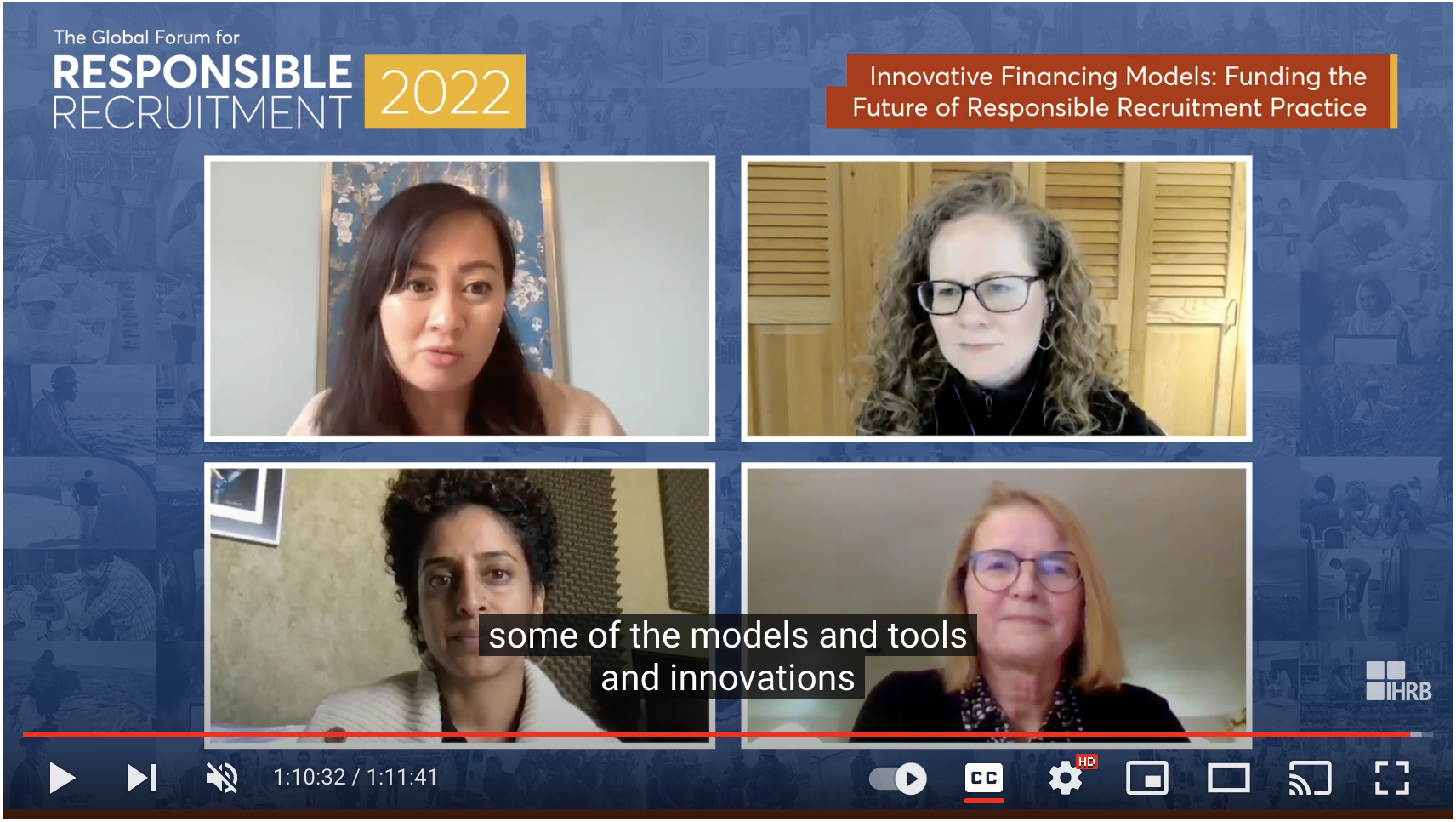
Jane Newman, International Director at Social Finance, UK Rupal Patel, US Senior Program Manager at Stronger Together and Founder & Principal at Good Scout Capital Elicia Carmichael, Senior Advisor at Labor Mobility Partnerships (LaMP)
MODERATOR
Anbinh Phan, Director, Global Government Affairs and Business Diplomacy at Walmart
ABOUT THE EVENT
This session was part of the Global Forum for Responsible Recruitment convened by the Institute for Human Rights and Business (IHRB). The session featured emerging innovative financing tools to incentivize responsible recruitment practices and explore the potential impact and benefits of these models for workers, recruiters, and employers. Specifically, the panelists focused on the outcomes-based smart subsidy model recently introduced by Social Finance and the outcomes-linked favorable finance model explored by the Labor Mobility Partnerships (LaMP). The goal of the session was to encourage participants to explore how financing solutions may be relevant tools to foster responsible recruitment in their contexts.
Guatemalan workers have a strong value proposition. Cruise guests want to see more workers that represent the countries they are visiting on their vacation to have a more genuine experience.
MAIN TAKEAWAY:
Creating a pipeline of qualified and trained job seekers from Guatemala can help respond to the labor shortages of the cruise industry and create more job opportunities for workers. The cruise industry operates on a global level and can offer competitive wages, professional growth, and an opportunity for workers to see the world. However, for Guatemala to unlock this opportunity, workers need better access to English language and hospitality skills trainings, including access to funding as well as enough time to invest in these trainings, and a formalized recruitment industry in this sector that can respond quickly to the growing needs of the cruises.
LaMP TEAM REFLECTION:
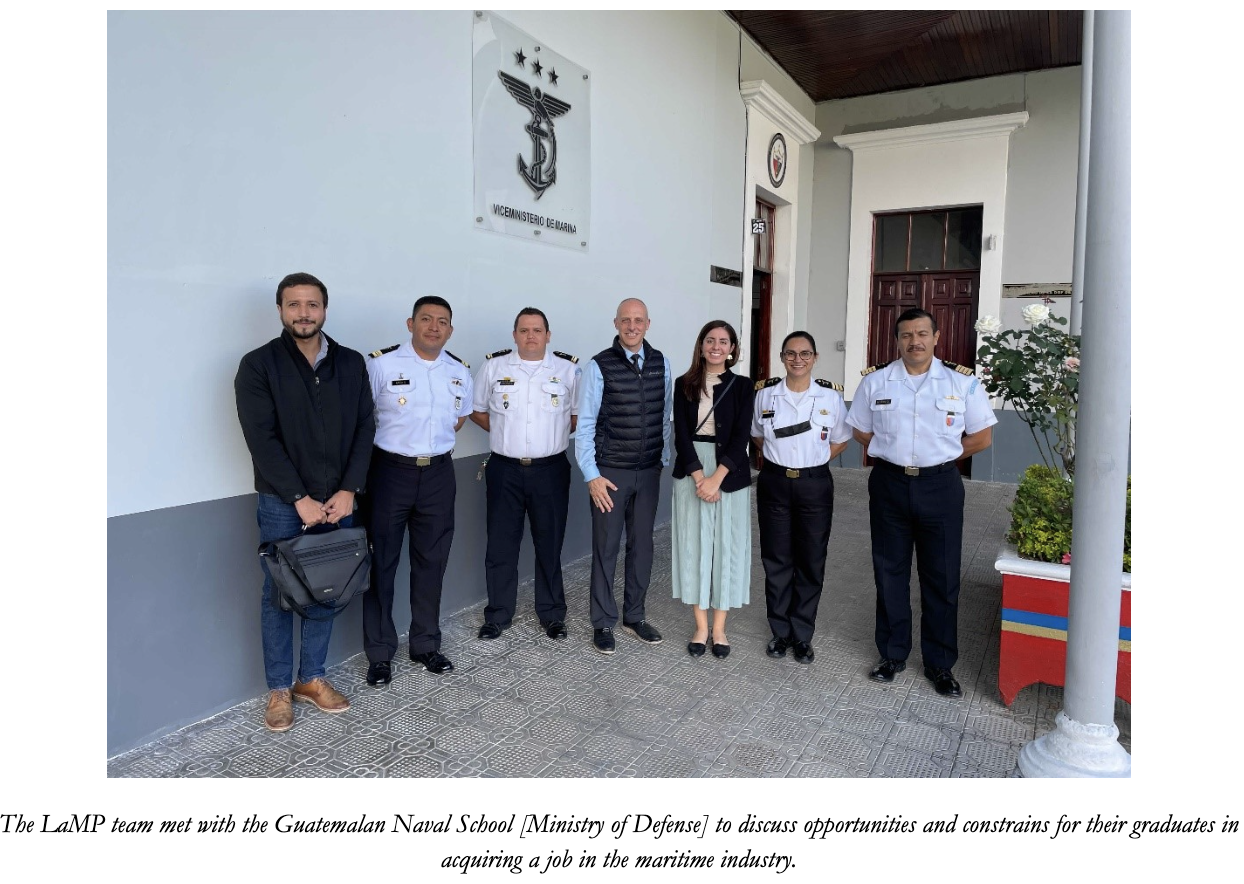
The LaMP team kicked-off a series of scoping trips to dive deeper into opportunities for intra-regional labor mobility in Ibero-America. First, the team traveled to Guatemala to get a better understanding of the worker supply side. We met with stakeholders in Guatemala to better understand the potential impact of increasing job opportunities in the cruise industry for Guatemalan workers. Specifically, we discussed the matter with the government, non-profit organizations, training institutions, and recruiters, who could possibly support building of responsible recruitment industry within the sector, meeting the needs of the cruises while expanding the pool of circular employment opportunities for Guatemalans. During these meetings LaMP discussed concrete concerns and strategies to better prepare jobseekers for the industry, improve institutional collaboration, and reduce the risk of exploitation for workers who wish to work at sea.
The following week, we participated in the Florida Caribbean Cruise Association (FCCA) Annual Conference in the Dominican Republic to get more insights into the employers’ perspective and needs. At the conference, we discussed employment needs in the industry, especially following the halt during the COVID-19 pandemic. During the opening ceremony speakers emphasized that hiring more workers from the Latin American region is one of the industry’s key priorities. The LaMP team engaged with cruise executives and delegates from the region to better understand the cruise lines recruitment challenges and how to harness opportunities specifically in Central America. To successfully increase hiring in Central America for cruises, countries need to create a qualified pool of candidates that is trained, ready to live at sea and speaks English. It is critical to establish a reliable and responsible recruitment market that can respond to the industry’s needs, match workers to jobs and prevent exploitation. Governments need to coordinate closely with cruises to ensure workers are trained according to their needs. And cruises need to coordinate closely with governments to ensure that a responsive recruitment market is set in place.
The LaMP team now takes this knowledge to start designing a pilot, helping incentivize jobseekers to invest in trainings which can ultimately result in a job offer in the cruise industry, while also channeling the cruise lines’ interest to hire from Guatemala and Central America more broadly. The team is now working with cruises, recruiters, training institutions and other stakeholders that expressed interest in continued collaboration.
To stay tuned for more details, don’t forget to sign up for our newsletter here and follow us on twitter!
Branko Milanović, the world’s leading economists focused on inequality
James Robinson, economics and political science professor at University of Chicago
Rebekah Smith, Executive Director of Labor Mobility Partnerships
ABOUT
While borders have the ability to divide countries both politically and socially, wealth drives an even bigger wedge between us. How do we make sense of the fact that the wealthiest country in the world, the United States, borders one of the poorest countries: Mexico? Despite efforts to mitigate this, global wealth inequality still appears to be growing. According to the World Inequality Report, the poorest half of the global population owns just 2% of the total global wealth.
In this episode of the Entitled podcast explored some of the ways we could fix global wealth inequality.
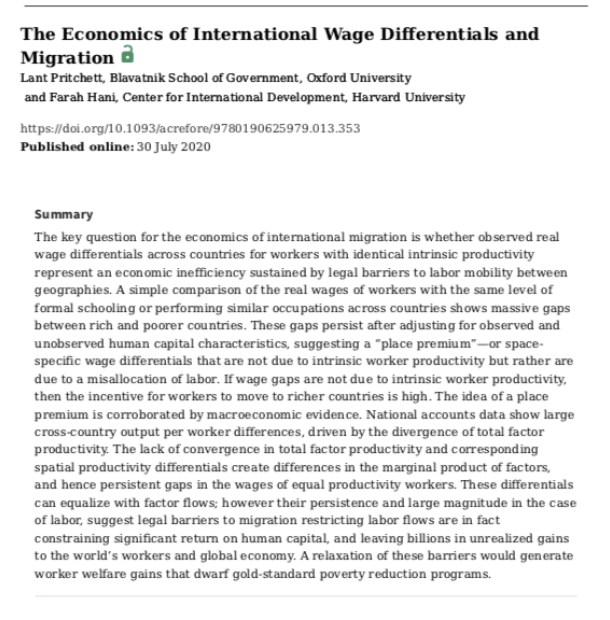
The key question for the economics of international migration is whether observed real wage differentials across countries for workers with identical intrinsic productivity represent an economic inefficiency sustained by legal barriers to labor mobility between geographies. A simple comparison of the real wages of workers with the same level of formal schooling or performing similar occupations across countries shows massive gaps between rich and poorer countries. These gaps persist after adjusting for observed and unobserved human capital characteristics, suggesting a “place premium”—or space- specific wage differentials that are not due to intrinsic worker productivity but rather are due to a misallocation of labor. If wage gaps are not due to intrinsic worker productivity, then the incentive for workers to move to richer countries is high. The idea of a place premium is corroborated by macroeconomic evidence. National accounts data show large cross-country output per worker differences, driven by the divergence of total factor productivity. The lack of convergence in total factor productivity and corresponding spatial productivity differentials create differences in the marginal product of factors, and hence persistent gaps in the wages of equal productivity workers. These differentials can equalize with factor flows; however their persistence and large magnitude in the case of labor, suggest legal barriers to migration restricting labor flows are in fact constraining significant return on human capital, and leaving billions in unrealized gains to the world’s workers and global economy. A relaxation of these barriers would generate worker welfare gains that dwarf gold-standard poverty reduction programs.
Our seniors deserve the care they need and the many workers around the world deserve the chance to get a good job within aged care through safe, reliable and sustainable labor mobility.
The LaMP team organized a workshop on why and crucially how to expand legal pathways in the elderly care sector as part of the Metropolis conference in Berlin, Germany. The session received a great response and spurred interest of many different audience members as we brought a unique combination of perspectives.
We learned about the needs of employers from the European Aging Network, how to design pilot pathways for governments from Australia’s Department of Foreign Affairs and Trade and how to move workers in practice with responsible recruiters from Staffhouse International Resources from the Philippines. Finally, our very own Sophia Wolpers outlined approaches and tools with potential to address worker shortages in the aged care sector.
We were also honored to have Senator Ratna Omidvar of Canada highlight LaMP in her closing plenary session as an example of the way forward in labor mobility.
The LaMP team also attended CARE 4.0 conference in Vienna, Austria, connecting with and learning from service providers from all around Europe about the challenges within the elderly care sector and emphasizing the importance of quality labor mobility in addressing of these issues.
LaMP TEAM REFLECTION:
Through these unique opportunities, the LaMP team got a chance to engage with many actors within the elderly care, providing technical and strategic guidance on creating mobility pathways for the sector. As a result, we had connected with speakers and audience members alike on how to move our ideas forward in practice.
However, engagement with specifically the individual employers stressed the nuances and uniqueness of this sector, which need to be reflected in any programming focused on elderly care. It is critical that any mobility pathway created to bring foreign workers to help take care of one of the most vulnerable populations – the elderly – includes rigorous skills and language training allowing them to provide high-level services that go beyond the “basic” needs of the residents and patients. At the same time, this training must be done in a way that allows the workers to start at their jobs within a reasonable timeline, providing them with an opportunity to improve their lives while also helping employers to address the growing labor scarcity within the sector.
LaMP has accepted the challenge of solving this delicate and very complex set of issues. We are now turning our attention to plans for the next year, which include new areas of work in the sector to address the individual hurdles and an increased focus on how to build a movement around labor mobility in the elderly care sector as a pathway to prosperity and equality.
The earliest stages of recruitment lay the foundation for seasonal agricultural workers’ experience in the U.S., yet they are also the most opaque, informal, and least regulated. Simple mechanisms that leverage worker voices to infuse transparency in early-stage recruitment practices may be the most promising way to improve oversight. By increasing accountability in recruitment and empowering workers as agents for change, these mechanisms are an important step for improving worker protection from day one.
The temporary agricultural worker visa program, or H-2A, creates hundreds of thousands of job opportunities for foreign farmworkersand is a critical solution to growing labor shortages in U.S. agriculture. However, it is not uncommon for workers to experience misleading, extortionary, or fraudulent recruitment practices. Too often workers end up paying illegal recruitment fees, or taking jobs without receiving important information, like wage and contract terms. Enforcement efforts have been insufficient to combat these issues, in large part because the recruitment process is fragmented with workers passing through different stages with multiple layers.
At every step of the recruitment process, workers interact with different players. In the most fragmented of cases a worker may have talked to a few community contacts with job information, a recruiter, a visa facilitator, and a consulate officer – all before heading to their worksite. Each holding a small piece of access to the job opportunity.
The earliest stage of recruitment is the most informal and least regulated. “Early-stage recruitment” refers to practices and experiences occurring in the worker’s country of origin before they reach the visa application stage. It includes information-sharing about job opportunities, working conditions, the application process, and the selection of candidates to be considered for jobs. Who workers engage with during the earliest stage of recruitment is completely dependent on who in their community is a gatekeeper for access to jobs. For some it may be finding a Facebook ad. A “guy” coming into their community looking for workers. A family member that just came back from a similar work experience. Some employers may ask a worker they trust to find more workers, thus giving that person full power and responsibility over recruitment. Others might be approached by a formal recruitment agency.
Why does early-stage recruitment matter? Malpractice in the earliest stages of recruitment creates an unfair power imbalance for the workers, making them more vulnerable to abuses at the workplace and harder for them to seek a fair grievance process down the line. The early-stage recruitment process can be totally informal and often begins by word of mouth. The individual recruiting may not be even affiliated in any official way to the employer, making the employer blind to practices occurring before workers reach their farm. These blind spots can expose employers and others in their supply chain to lack of regulatory compliance and legal repercussions. In the worst of cases, traffickers and criminals target prospective workers to exploit them, promising job opportunities in exchange for illegal fees. A study done by the Polaris Project reported that the median amount of recruitment fees reported to their trafficking hotline roughly amounted to a whopping $4,000.
In practice, there is very little oversight of the earliest stage of an H-2A worker’s journey. Many existing efforts focus on ensuring responsible practices on the job or by the employer of record. This is critical and targets some of the most egregious issues seasonal guestworkers encounter. But few existing solutions directly address agents engaged in early-stage recruitment. Traditional methods of top-down enforcement are complicated by the fragmentation and informality that characterizes the recruitment process. A different way to create transparency and oversight is needed.
A bottom-up mechanism for continuous improvement of early-stage recruitment practices could bring greater transparency in recruitment. At LaMP, we are collaborating with CIERTO Global and the Equitable Food Initiativein the design of a low-cost, accessible mechanism to monitor and build capacity for better recruitment practices. The mechanism would utilize worker feedback to shed light on recruiters’ early-stage processes. This information would be complemented with support to recruiters to make strides towards a safer, fairer, and more predictable process for workers.
The mechanism would create greater accountability for recruiters and visa facilitators, transparency for employers and retailers, and empower workers to be part of systems improvement. Direct worker surveys on recruitment practices, anonymously aggregated and analyzed by a third-party organization, represent an independent source of information that gives employers and retailers greater visibility into worker experiences. In turn, these powerful stakeholders can hold recruiters responsible for making improvements.
The mechanism would also provide continuous indicators of quality, which could be linked to tangible benefits for recruiters, such as privileged access to potential clients, business mentorship, and financing solutions. This is critical, because if responsible early-stage practices are to be sustainable in a competitive market, they must be paired with benefits that create a market advantage for responsible recruiters or their clients.
If early-stage recruitment practices are overlooked, we will continue to leave blind spots in our ability to protect seasonal workers. We at LaMP are looking for partners to help us design business benefits for responsible recruiters committed to improving their systems. Please reach out if you want to collaborate or have ideas!
The research included in this blog was made possible by the support of the Walmart Foundation. The findings, conclusions, and recommendations presented in this blog are those of Labor Mobility Partnerships (LaMP) alone, and do not necessarily reflect the opinions of the Walmart Foundation.
Be part of the movement shaping the future of global labor mobility. Connect with leaders across recruitment, training, finance, technology, government and investment to establish a shared vision, address sector-wide challenges and accelerate collective progress.